Back Cut-Out Sports Bras: Why Ventilation Placement Matters More Than Coverage
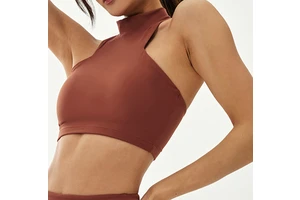
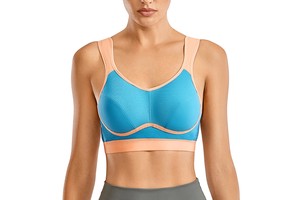
Most design briefs for back cut-out sports bras argue about how much fabric to remove and almost never about where. That is backwards. A medium impact bra for spin, rowing or dance already has a limited amount of load-bearing cloth, and the coordinates at which you remove it determine both comfort and structural integrity. Buyers who approve a cut-out by area alone routinely sign off on panels whose edges land across the shoulder blades, then field chafe and restriction complaints that no softer fabric will fix.
Sweat Is Not Evenly Distributed
Perspiration mapping work consistently shows high local sweat rates along the spinal column and the paraspinal region, with lower rates over the lateral aspects of the back. Effective ventilation therefore targets the centre back, which is also where the vertical bar of a racerback already opens the garment up. Adding a secondary keyhole at the lower back or alongside the vertical bar increases airflow through a channel that already exists, rather than punching a new hole in a structural area.
Ask your mill for quantified transport data rather than breathability claims. ISO 11092 specifies measurement of thermal and water vapour resistance using a sweating guarded hotplate; a lower evaporative resistance figure means better vapour transport. Request that report for the shell fabric and separately for the assembled back panel including any lining or mesh insert.
Edge Placement and the Moving Scapula
The shoulder blades are not static anchors. They rotate and glide considerably during rowing, overhead work and dance choreography. A cut-out edge crossing the medial border of the scapula will be rubbed thousands of times per session. The practical rule experienced pattern makers apply is straightforward: the large rear opening should be positioned to clear the scapular region rather than to frame it, finishing below or medial to the area that moves.
Verify it on a live model performing the target sport through full range, never on a static dress form. Photograph the extremes of protraction and retraction and confirm no edge crosses mobile bone at either limit.
Every Opening Has to Be Paid For
Removing fabric removes a load path. If tension normally travels from band to strap through the area you deleted, it will reroute through the remaining seams and stretch them out over time. Compensate by widening the underband, by adding stabilising tape along the perimeter, or by adjusting orientation so tension lines bypass the aperture. This is why ventilation and support should be reviewed in the same sample meeting rather than in separate packs.
Edge Finish Options
Four finishes are realistic at production scale: turned and topstitched, elastic-bound, bonded film tape, and laser-cut sealed edges on synthetic knits. Bound and bonded finishes both introduce a layer whose elongation must approximate the shell, otherwise the edge curls or waves after washing. Require AATCC 135 dimensional change results on finished panels, and inspect for roping along the perimeter after the specified number of cycles.
Tolerance and Inspection
Cut-outs amplify visible variance. A nominally symmetrical opening whose two halves differ by only 2 mm reads as a defect to the consumer even when function is unaffected. State symmetry tolerances explicitly in the measurement section of your inspection protocol and inspect against them at AQL 2.5 for major defects. Recording measurable coordinates in the tech pack is considerably cheaper than discovering them later in returns data.